
October 6, 2026 | Canadian International Trade News
Canada recorded a significantly larger merchandise trade surplus in August 2026, supported by rising exports and declining imports, according to the latest data released by Statistics Canada on October 6.
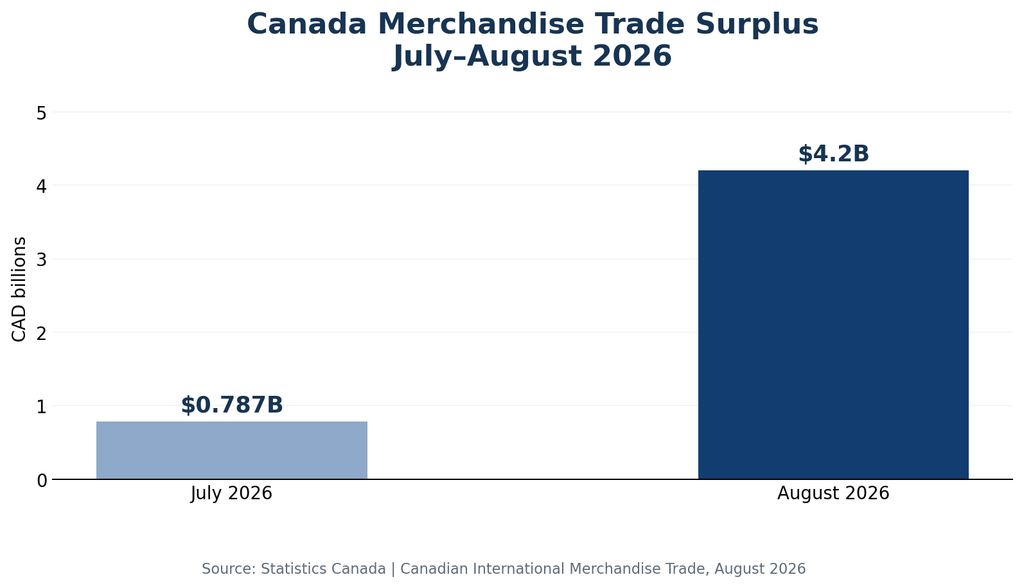
Canada’s merchandise trade surplus with the world reached $4.2 billion in August, compared with $787 million in July, marking the sixth consecutive monthly merchandise trade surplus.
Total merchandise exports increased by 2.5% to $77.9 billion, while imports declined by 2.0% to $73.7 billion.
The combination of stronger exports and lower imports contributed to the substantial increase in Canada’s monthly trade surplus.
Export Growth Supports Canada’s Trade Performance
According to Statistics Canada, exports increased across eight of the country’s 11 major commodity sections in August.
Energy exports returned to growth after several months of weakness. Even when energy products were excluded, total merchandise exports increased by 1.8%.
This indicates that export growth was not driven solely by the energy sector, although different industries continued to experience varying market conditions.
Exchange rate movements also played a role in the reported trade values.
The average value of the Canadian dollar increased by 1.1 US cents in August compared with July. As a result, businesses analyzing international trade trends should consider both changes in physical trade volumes and the impact of currency movements on reported values.
Imports Decline as Global Supply Chains Continue to Adjust
Canada’s merchandise imports fell 2.0% in August.
However, the overall decrease does not necessarily indicate weaker demand across every imported product category.
Statistics Canada reported lower imports of crude oil from Saudi Arabia and certain passenger vehicles from Japan and South Korea.
These declines were partially offset by higher imports of aircraft and vehicles from Germany, as well as various products from China.
For businesses operating in international trade, these differences highlight the importance of reviewing individual product sectors and sourcing markets rather than relying exclusively on headline import figures.
Trade Diversification Remains an Important Consideration
Although Canada’s overall merchandise trade surplus widened, exports to destinations other than the United States declined by 8.5% in August compared with July.
Meanwhile, Canada’s merchandise trade deficit with countries other than the United States increased from $5.3 billion in July to $7.0 billion in August.
These figures demonstrate that improvements in Canada’s overall trade balance do not necessarily reflect uniform growth across international markets.
For Canadian importers and exporters, supplier diversification, market selection and landed-cost management remain important strategic considerations.
What Does This Mean for Canadian Importers and Exporters?
Canada continues to maintain substantial international merchandise trade activity. However, tariff policies, currency fluctuations, market demand and supply chain adjustments can all influence business costs.
Companies engaged in cross-border trade should pay particular attention to:
- Tariff Classification: Ensuring imported goods are classified under the appropriate HS codes and customs tariff provisions.
- Country of Origin and Trade Agreements: Determining whether goods qualify for preferential tariff treatment under applicable free trade agreements.
- Import Compliance: Reviewing regulatory requirements administered by the CFIA, Health Canada and other participating government agencies.
- Shipping and Customs Planning: Preparing accurate commercial documents and coordinating ocean, air and highway shipments to help prevent avoidable clearance delays and additional expenses.
Canada’s August trade figures demonstrate that international trade remains substantial, even as conditions vary across markets and product categories.
For businesses, changes in the global trading environment are reflected not only in national economic indicators but also in purchasing decisions, customs duties, transportation costs and delivery timelines.
Official Source:
Statistics Canada — Canadian International Merchandise Trade, August 2026
Released October 6, 2026